
Author: Eric Gilliam
“Chaos isn’t a pit. Chaos is a ladder.” — Littlefinger, Game of Thrones
The Democratic party has been the “Party of the Working Man” since FDR and his pro-worker policies during the Great Depression. However, this title does not carry the same accuracy it used to. While two of the previous three presidents were Democrats, this did little to slow the decline of labor unions.
Voters noticed. The 2016 election brought about changes in voting trends that appear to be a direct response of this inaction. President Trump’s campaign found a way to capitalize on the chaos created by the lack of a true workers party. Worker disenchantment was his ladder to the presidency. However, many continue to wonder what exactly working class Trump voters saw in voting for the so-called “party of the rich”.
Findings
The Gallup US Daily Poll can help examine this phenomenon. The survey randomly polls 1000 Americans citizens daily on pressing issues. We will look at the responses of four separate groups of counties to these questions. The four groups polled are made up of respondents in counties that:
democrat: went Democratic in the presidential race in 2012 and 2016
republican: went Democratic in the presidential race in 2012 and 2016
flip_democrat: went Republican in 2012 and Democratic in 2016
flip_republican: went Democratic in 2012 and Republican in 2016
Looking at the data, it seems that traditionally Republican counties and counties that flipped Republican have similar views on state of the economy and similar labor markets. The only common ground that the flipped republican counties had with democratic counties was high levels of union membership. If these flipped voters were Democrats because of pro-union policies, then the Democrats must take a hard look in the mirror.
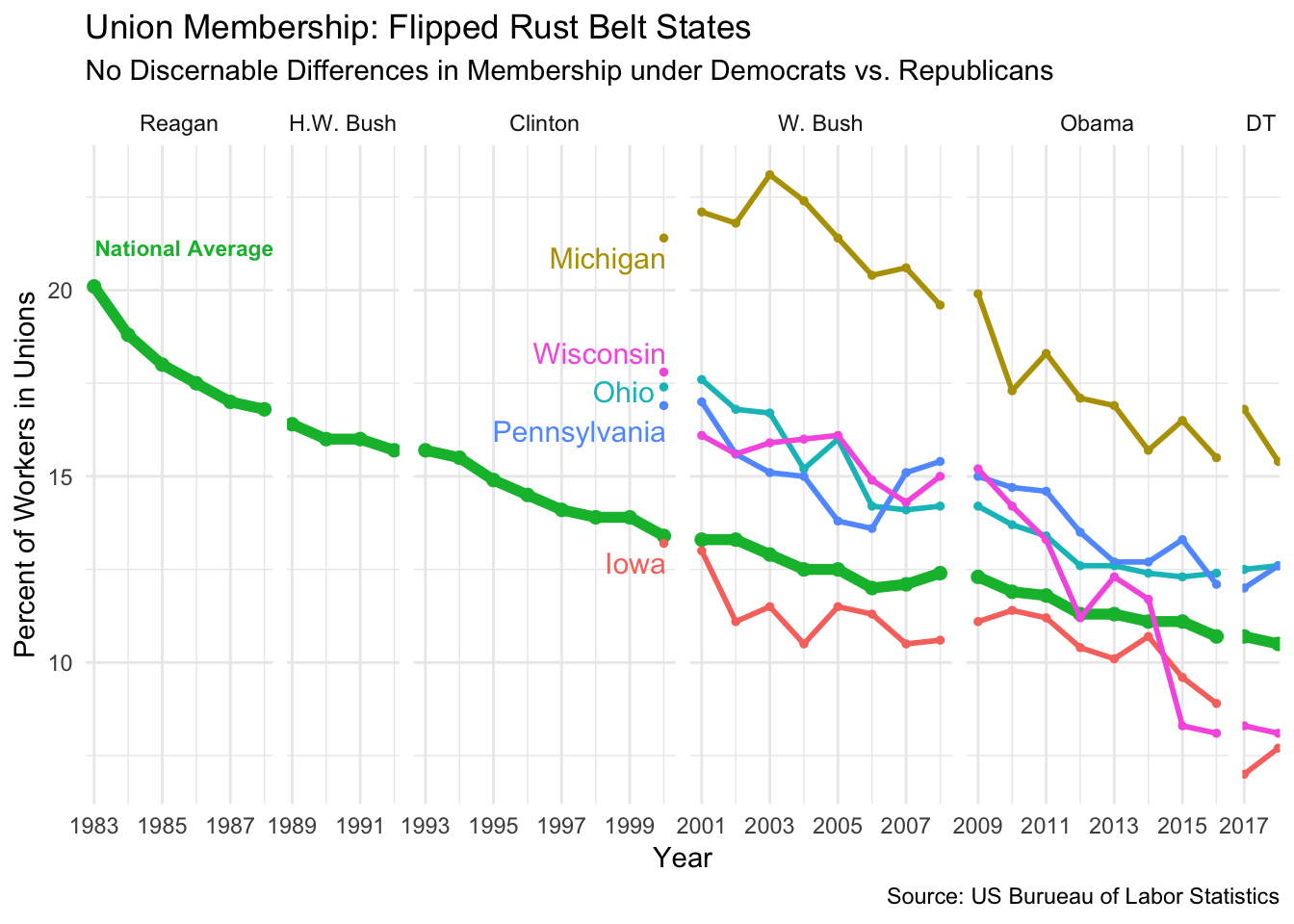
People generally vote as if what happens during a president’s tenure is that president’s responsibility, good or bad. The data indicate that Presidents Clinton and Obama were no more helpful to unions than President Ronald Reagan, an anti-union Republican.
Satisfaction With the Economy
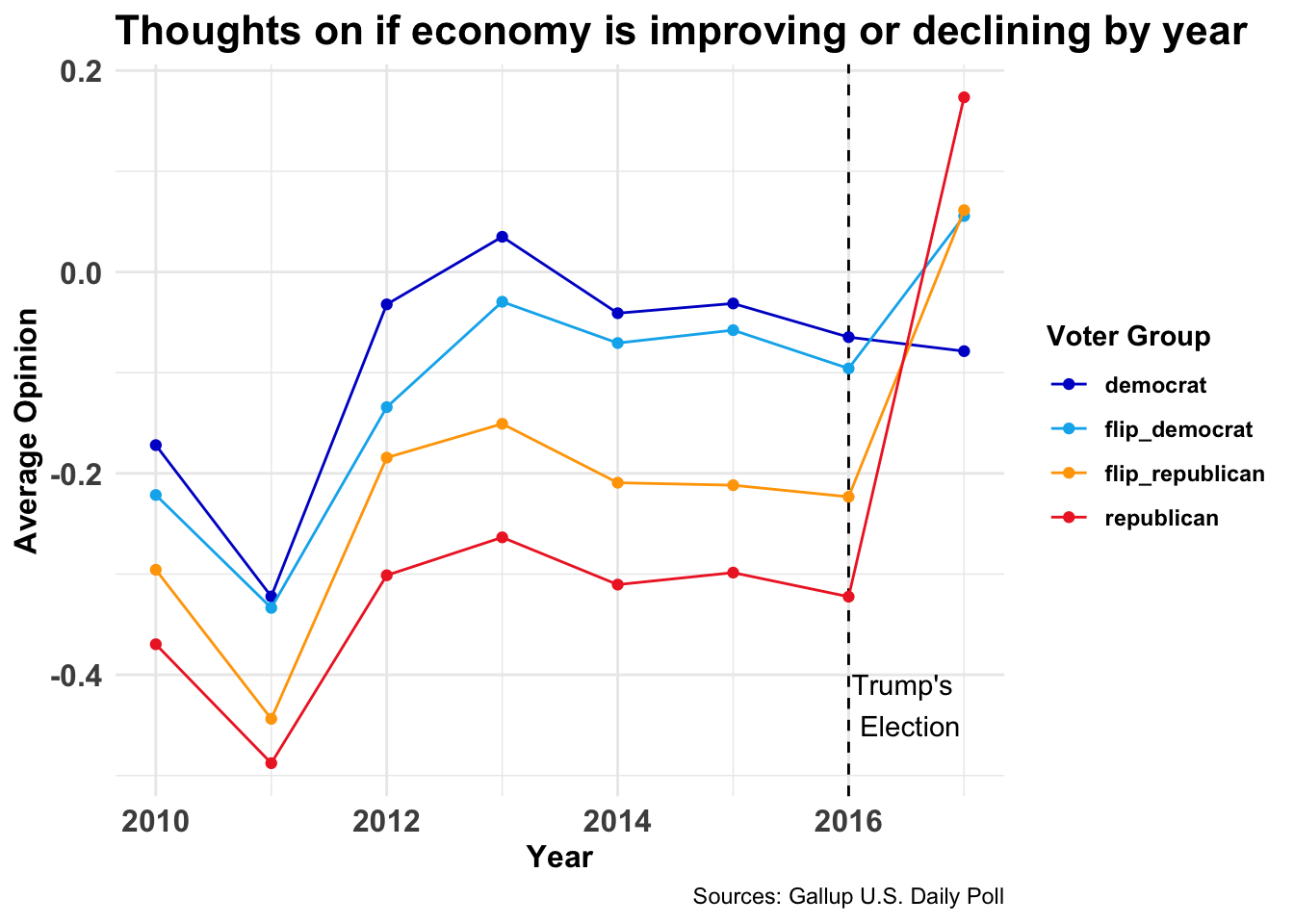 Prior to the 2016 election, both republican and flip_republican counties had
pessimistic views on the state of the economy. Since the election, the only
group that did not believe the economy had improved were democrat counties. Even
counties that flipped from Romney to Clinton had a positive views on the economy.
Prior to the 2016 election, both republican and flip_republican counties had
pessimistic views on the state of the economy. Since the election, the only
group that did not believe the economy had improved were democrat counties. Even
counties that flipped from Romney to Clinton had a positive views on the economy.
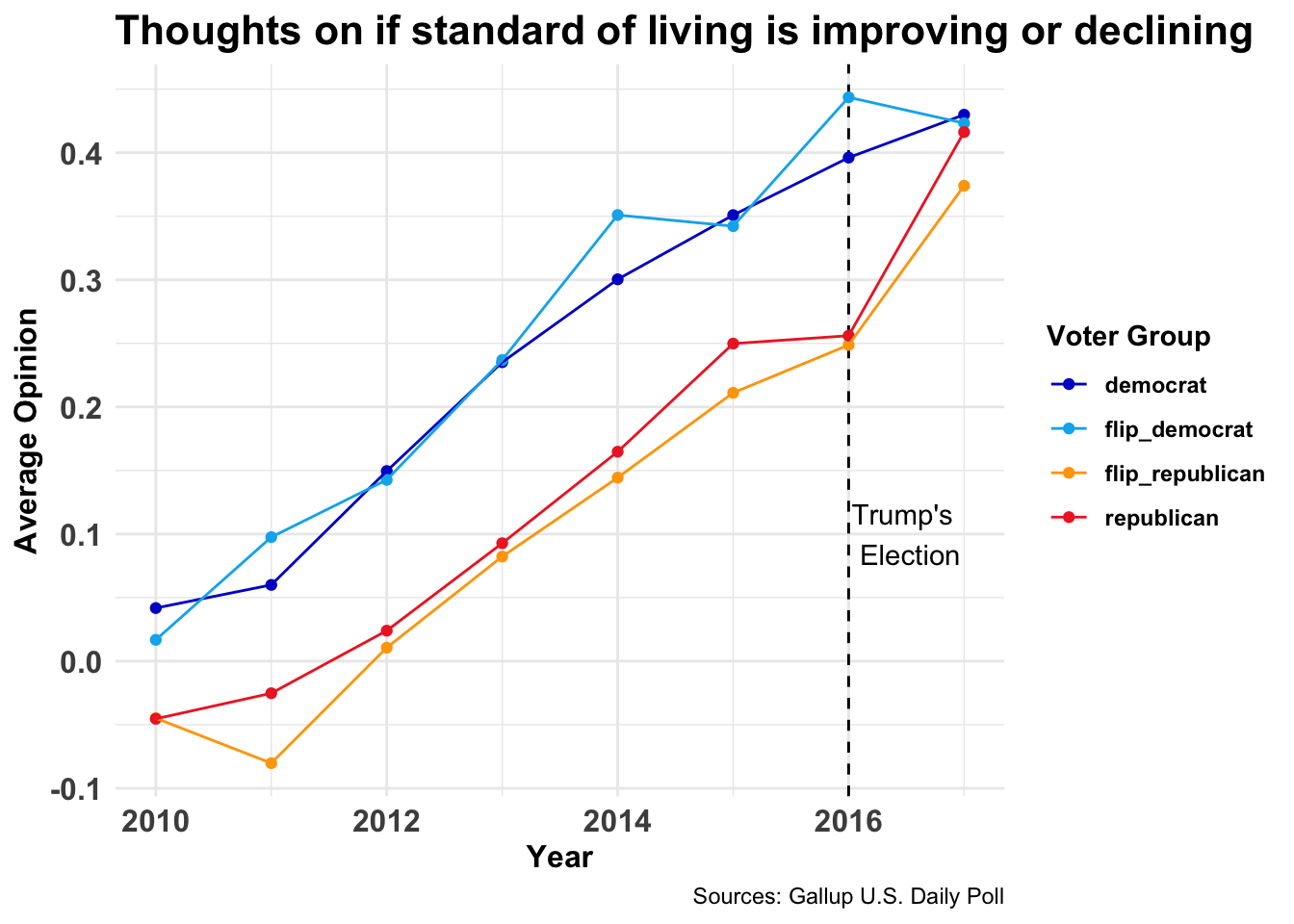
Trump counties tended to be pessimistic about the improvement of their standard of living prior to the election. In the year following the election, the pessimism diminished and the Trump counties became as optimistic as Clinton counties.
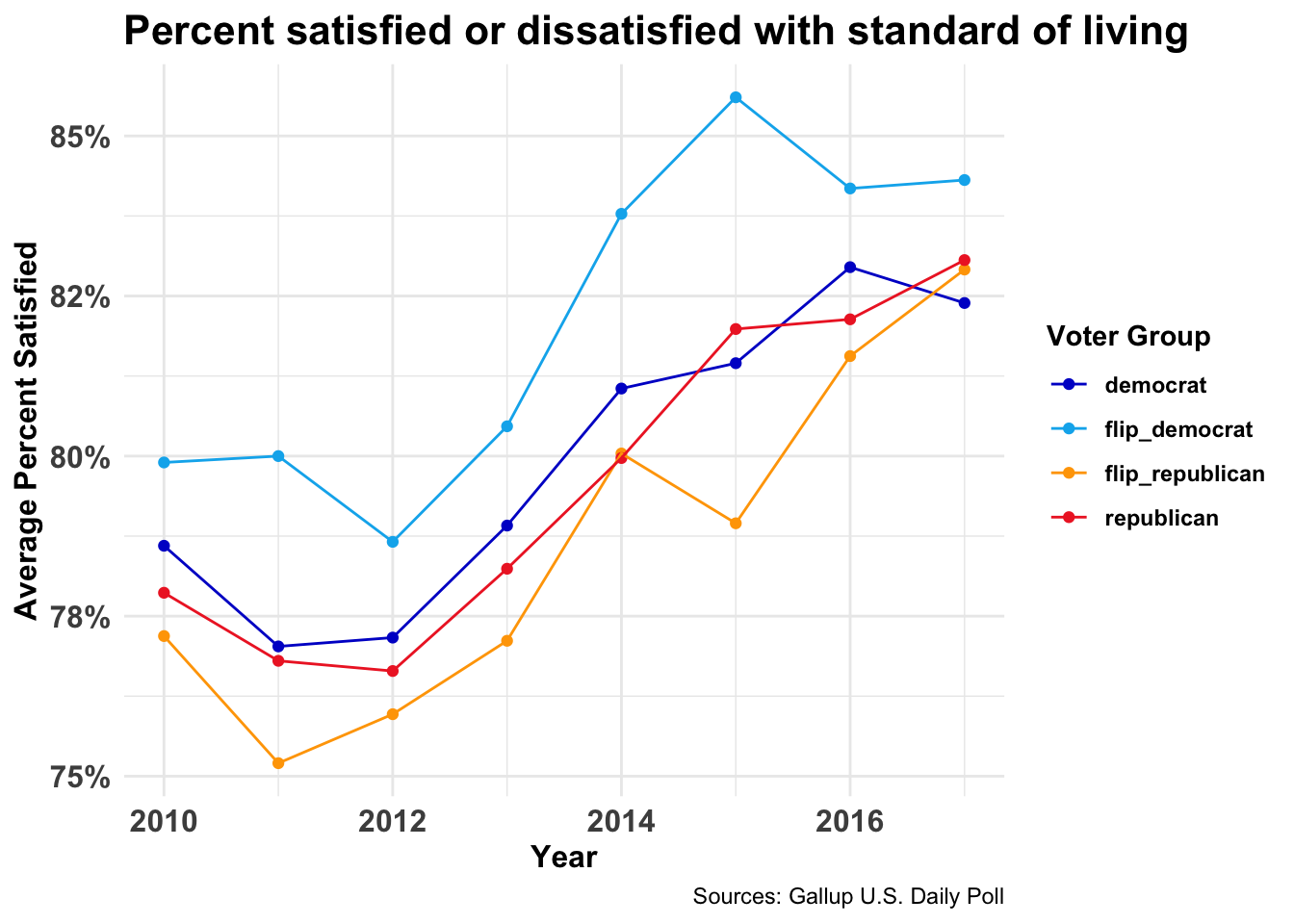
flip_democrats were the most satisfied with their standard of living. This would imply that the counties which flipped from Romney to Clinton were the most affluent Republican counties. Meanwhile, the disaffected Democratic voters, flip_republicans, were consistently the least satisfied counties prior to Trump’s election. These less forunate counties saw fit to vote in favor of the disestablishment candidate, President Trump.
Labor market differences among groups
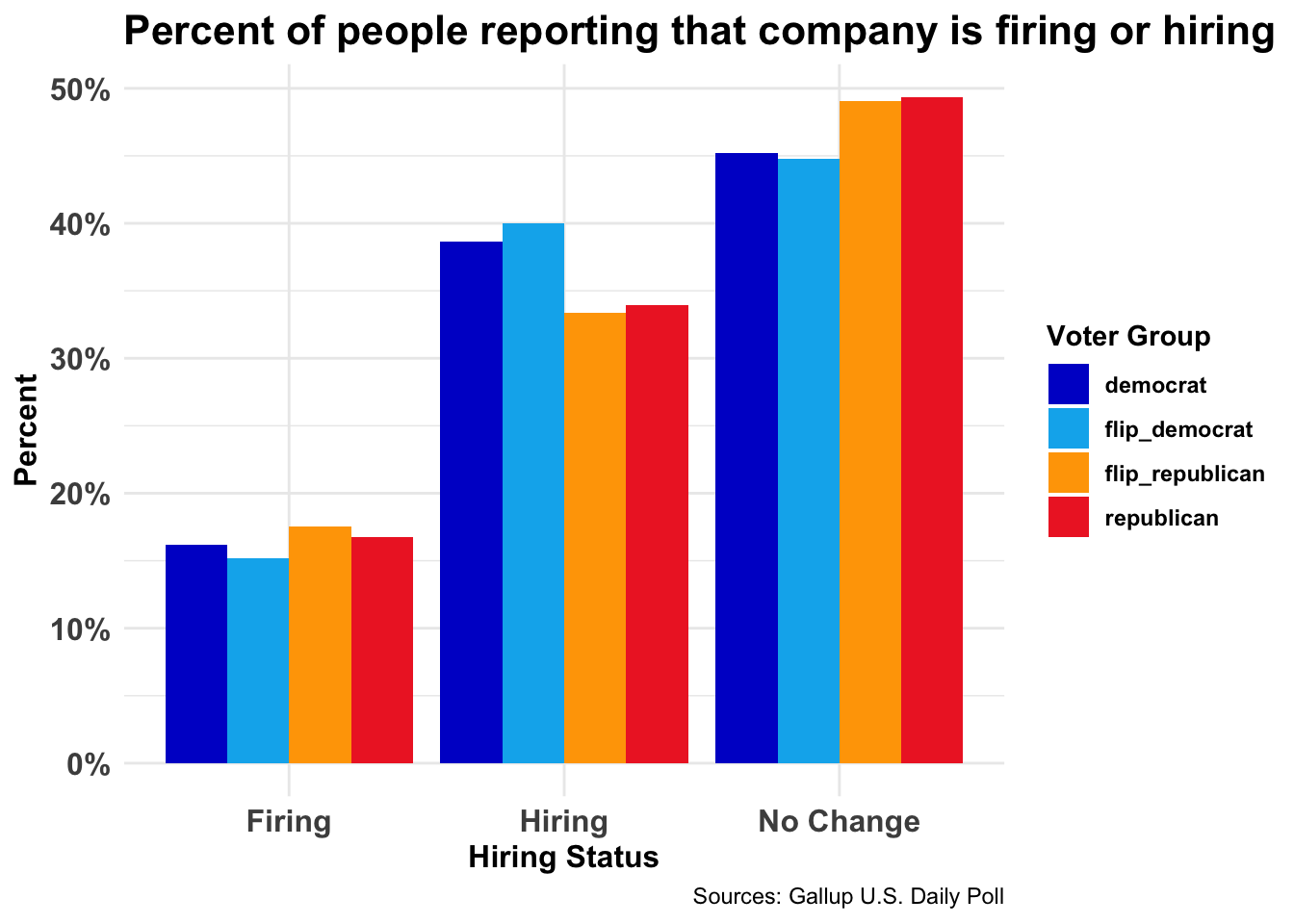
The Gallup poll asked respondents whether or not their company was hiring or firing employees. Counties that voted for Trump had significantly less hiring and suffered firings more frequently. This indicates higher unemployment in these counties.
David Autor, a labor economist from MIT, said to the New York Times that he believes “Some of it is globalization, but a lot of it is we require many fewer workers to do the same amount of work,”.
Much of the reason for the use of immigrants and trade deals as scapegoats is simple: it’s easier to blame a politician or an immigrant than a robot.
Next, we will look at types of jobs worked in each county. Office-based sectors mainly employ desk workers such as business analysts or clerical workers. Labor-based sectors, such as construction or manufacturing, primarily employ manual laborers.
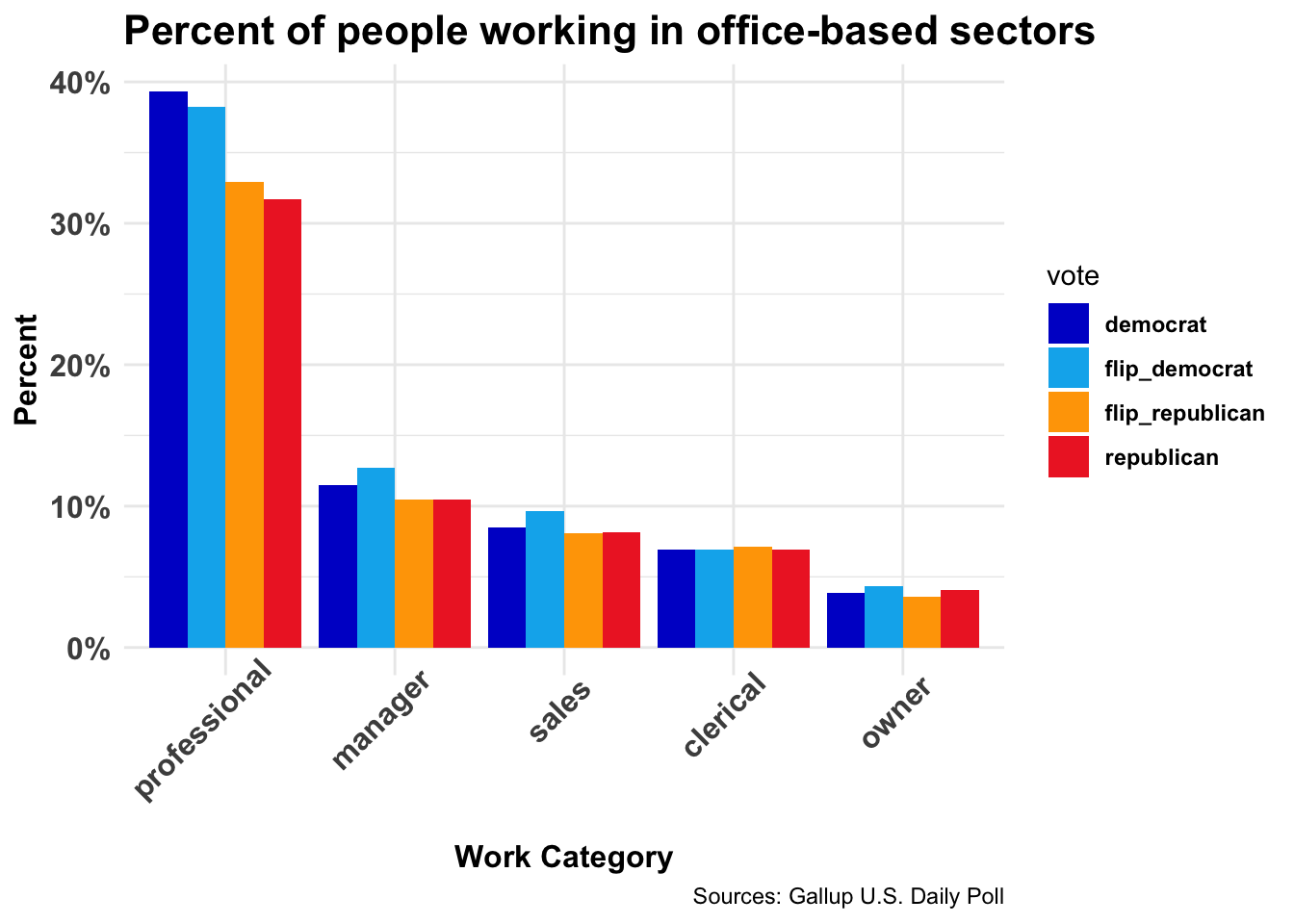
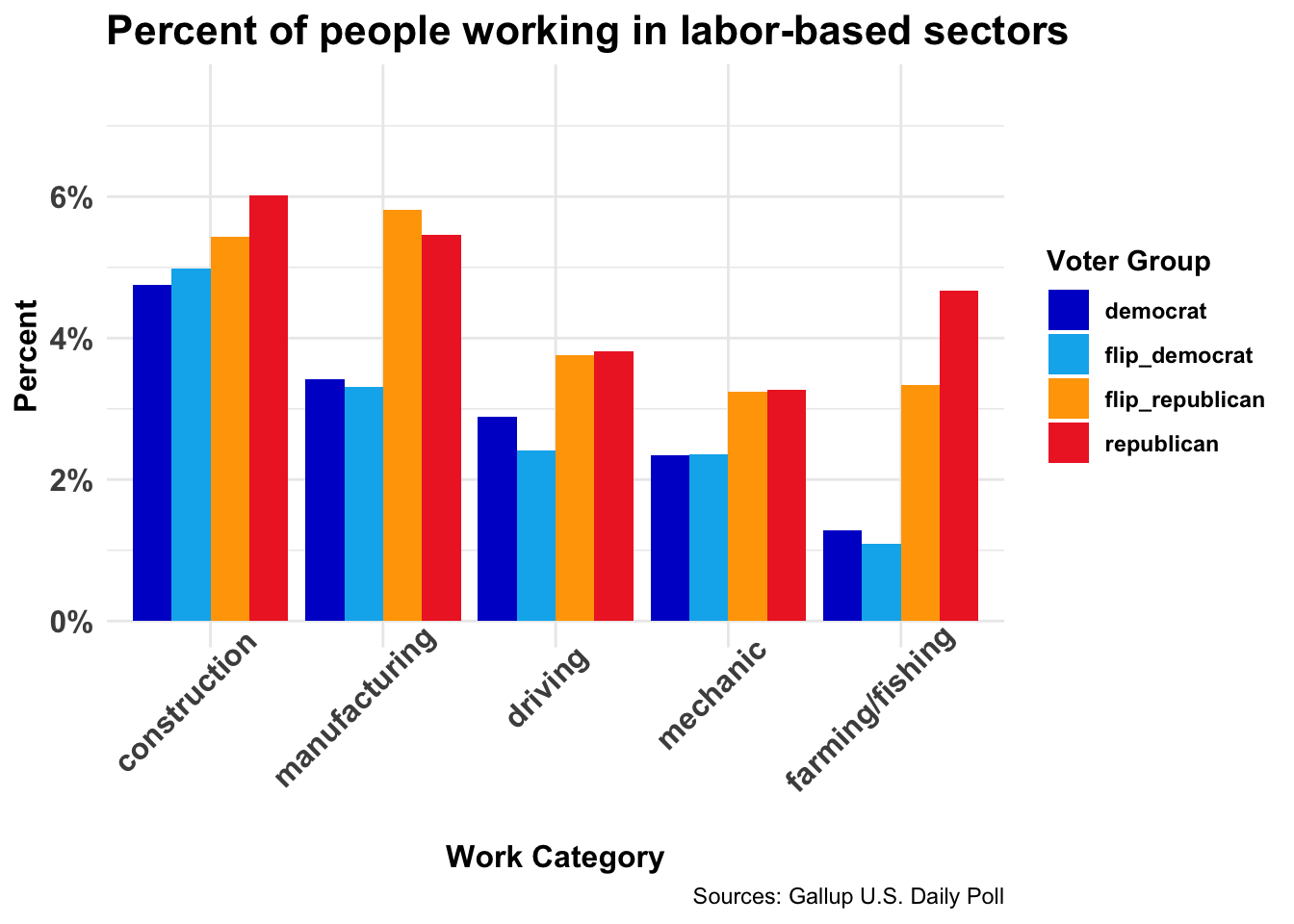
A higher percentage of Clinton counties work in office-based sectors, while the Trump counties have a higher percentage of individuals working in labor-based sectors. This white collar vs. blue collar divide proved to be predictive of how counties would vote in the election.
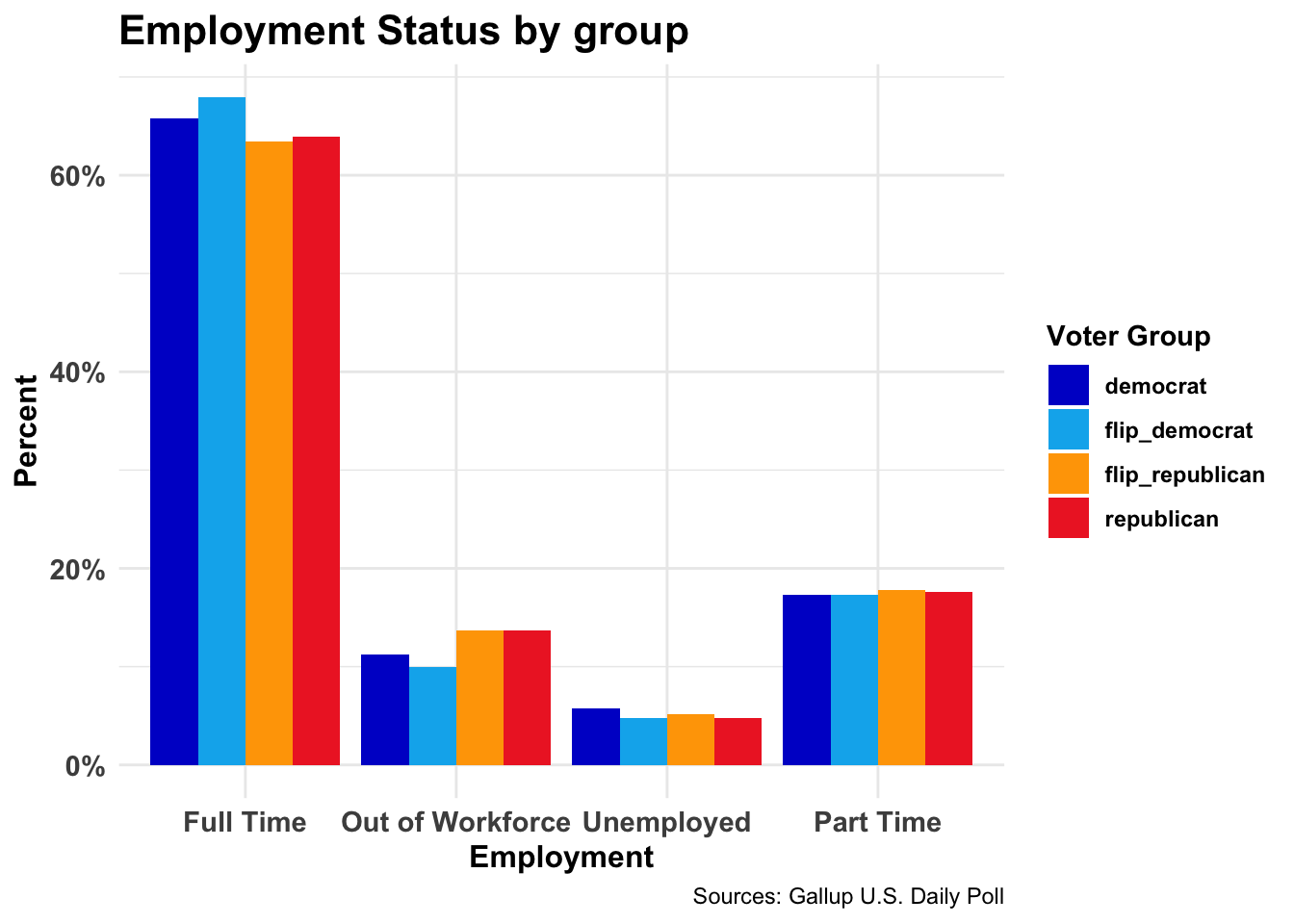
A higher proportion of Clinton voters are employed full-time. Trump counties do not appear to have significantly worse unemployment rates, but do have more workers who were reported to be ‘out of the labor force’. This means that Trump counties have a high percentage of individuals no longer looking for work. This is quite significant. Professor Caroline Hoxby, a Stanford Economics Professor, noted in an event on “Revisiting the 2008 Financial Crisis” that in the aftermath of the crisis,
“…labor markets really did not adjust quickly…leading to a much longer recovery, a much slower recovery, and in many ways a recovery that has never completely occurred. Despite the fact that we have low unemployment rates…The labor force participation rate fell very sharply during the Great Recession, immediately following the financial crisis, and it has never really recovered.”
She cited the increased uptake of government disability and education packages which allowed laid-off workers to collect paychecks while remaining out of the workforce. In light of this evidence, in the labor market she sees, “a lot of indications that the Great Recession to some extent still continues.”
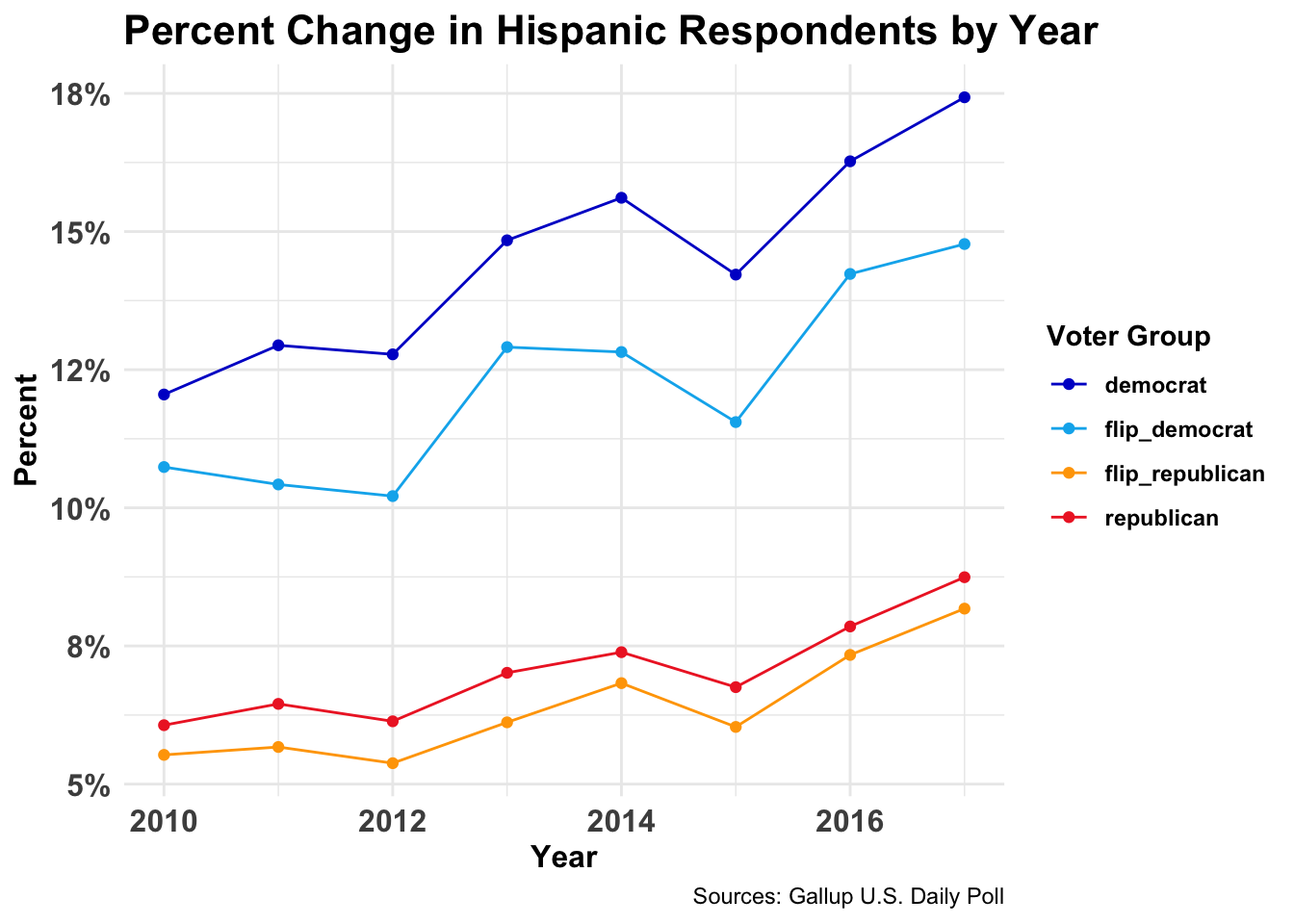
Trump counties tend to take the most issue with the rising number of immigrants in the United States; however, they have the lowest percent of immigrants. This does not mean that the complaints are invalid. The hispanic populations in Trump counties are still growing. Not to mention, these are the counties which already have low employment levels and are poorly suited to handle additional job-seekers.
A decaying bond
What did those counties which flipped to the Republican party ever have in common with the Democratic base? The above graphs show that they appear to be have been similar to the Republican counties since at least 2010.
The data did indicate one commonality.
The Democrats were traditionally the party of the working man. Worker protections and other pro-labor economic policies were a core part of the party’s economic platform. This might be why the flipped republican counties were previously voting for the party.
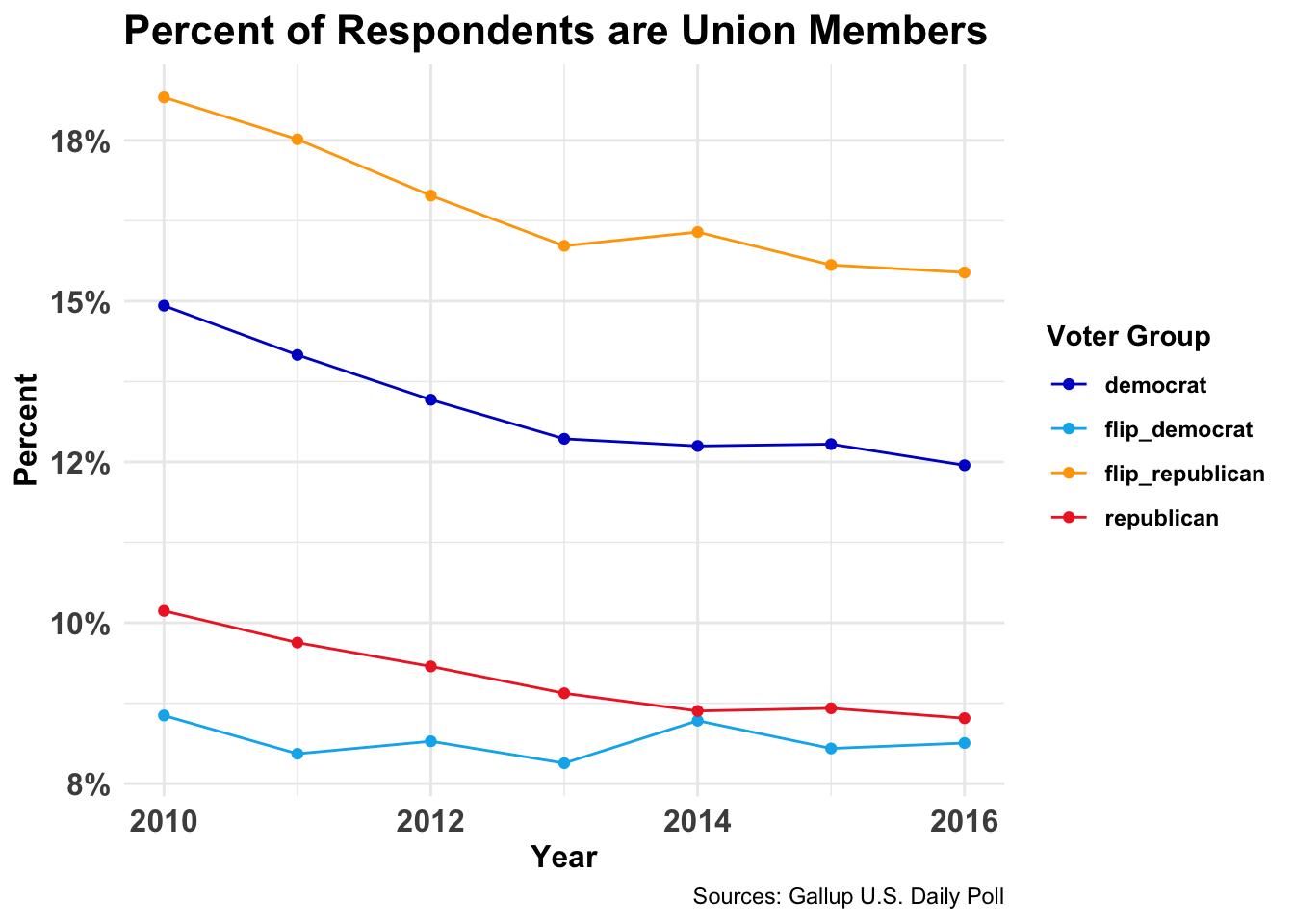
Globalization and innovation threaten many blue collar jobs; as a result, Trump counties tend to be the losers of increased globalization and innovation. These counties would benefit most from increased union membership. Why would these individuals opt to leave the ‘Party of the Working Man?’
The slow death of unions
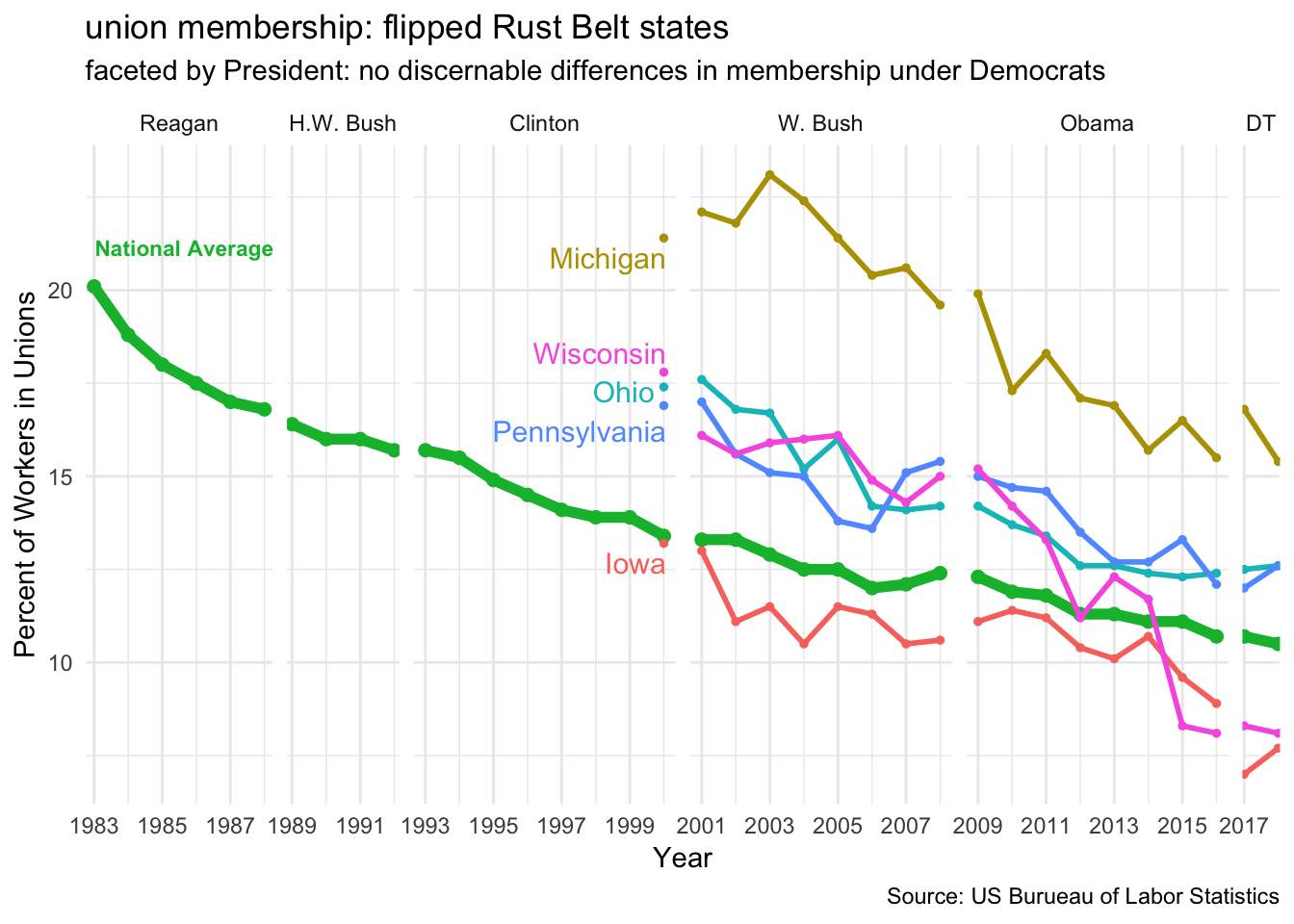
The above plot demonstrates exactly why the Democrats lost these pro-union counties. In recent years the Democratic Party has taken on a social platform catered towards urban areas with minorities as its focus. The party heavily backs issues such as the pro-choice movement and a push for open borders. It was believed that the Democrat’s traditional reputation of protecting workers rights and unions should still be appealing to these white, working class voters. However, Democratic presidents have brought no change to the decline in union membership.
It is unsurprising that those middle American counties with above average union membership would feel unrepresented by the new Democratic party. Much of the economic benefits package the new Democratic party has for these groups is an expansion of social safety nets. This includes social security expansions, Medicare for All, and direct redistribution of income to low and middle income workers.
These policies are not necessarily supported by these voters. While Gallup polls have found that most people believe the richest in the country do not pay enough taxes, they have also found that most citizens are satisfied with their “opportunity to get ahead.”
It is much more likely that these union voters crave some kind of effective reinvestment in their skills to prepare them to contribute to the new age workforce. A survey by Kenneth Scheve of Stanford University indicated that 45% of citizens would select this option instead of increases in protectionist policies or social safety nets.
If socially, the Democratic party expresses beliefs that do not represent these groups, and economically, these groups do not want what the new Democratic party is selling, why would these groups have any reason to vote for the Democrats?
This can’t help but leave one to wonder:
Which party will take up the the mantle of ‘The Party of the Working Man’ in response to the Democrats lack of action on the issue in recent decades?
If this mantle is not meaningfully picked up and used to make effective policy by either party, it is possible that these populist trends will continue.
.
.
References:
Gallup US Daily Tracking Poll https://www.gallup.com/home.aspx
Frank Newport, “Majority in U.S. Satisfied With Opportunity to Get Ahead”, Gallup, 2018. https://news.gallup.com/poll/228914/majority-satisfied-opportunity-ahead.aspx
Frank Newport, “Americans Still Say Upper-Income Pay Too Little in Taxes”, Gallup, 2018. https://news.gallup.com/poll/190775/americans-say-upper-income-pay-little-taxes.aspx?g_source=link_newsv9&g_campaign=item_228914&g_medium=copy
Kenneth Scheve and Matthew Slaughter, “How to Save Globalization,” Foreign Affairs, 2018.
“The Long-Term Jobs Killer Is Not China. It’s Automation.”, The New York Times, 2016.